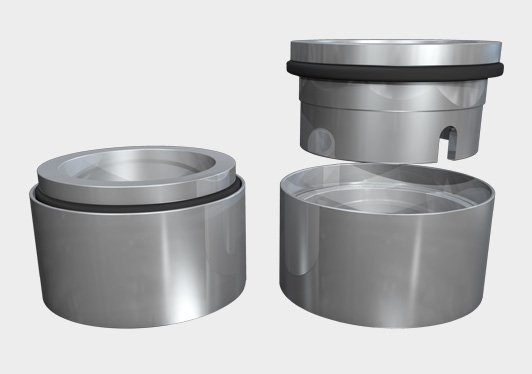
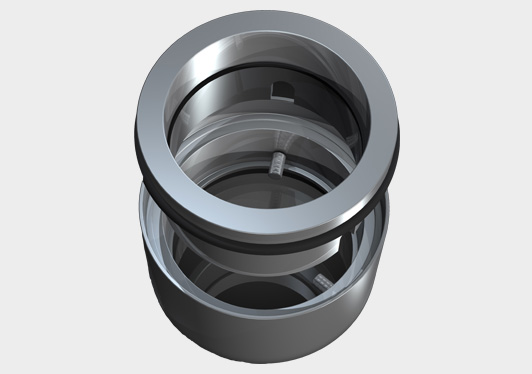
Primary Ring & Mating Ring
The main components of the mechanical seal are two parts sliding against each other: the spring-loaded primary ring and a mating ring. One of the two rings is fixed in the housing (stationary), while the other ring is mounted on the rotating shaft. Contact pressure on the axial faces achieves the automatic adjustment of a very narrow sealing gap.
A leakage flow forms in the radial direction through the sealing gap. The gap height is varied by an axial relative movement of the sealing faces, which is why the term axial seal is also common for the mechanical seal. Thanks above all to their very low leakage, mechanical seals are used across all fields of engineering. Compared with stuffing box packings, they have a considerably narrower sealing gap and lower friction.