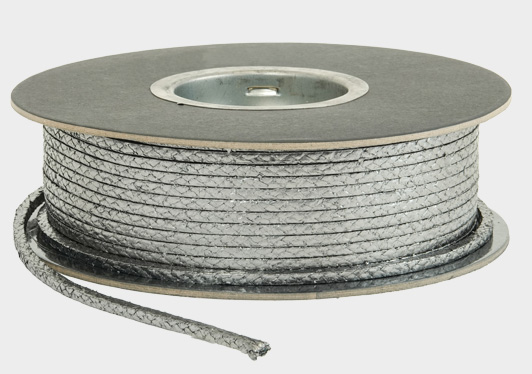
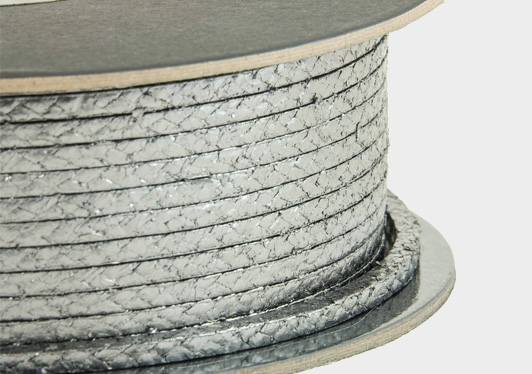
Axially compressed seal with radial pressure on the shaft, adjustable to wear during operation by re-tightening the gland follower.
A stuffing box consists of a gland follower and a stuffing box packing. The stuffing box packing is the actual seal; it is axially compressed via the gland follower by means of screws or springs. This axial compression expands the packing, producing a radial pressure on the shaft. The sealing gap is adjusted by the pressure of the gland follower.
Large contact areas and high compressive forces are required for sealing, which results in high friction. One advantage is that the seal can be adjusted to compensate for ongoing wear by re-tightening the gland follower, thereby reducing leakage.
Typical fields of application are pumps, agitators and spindle seals in control and regulating valves. With a suitable choice of materials, a stuffing box can also be used at higher temperatures (above 200 °C), unlike elastomer seals such as the O-ring.
A stuffing box packing (gland packing) is the actual seal in a stuffing box. It is axially compressed via the gland follower, which creates a radial pressure on the shaft that closes the sealing gap.
The packing is compressed axially by screws or springs via the gland follower and expands radially against the shaft. Wear can be compensated during operation by re-tightening the gland, keeping leakage low.
For pumps, agitators and spindle sealing in control and shut-off valves. Thanks to the material selection it can also be used at high temperatures above 200 °C, where elastomer seals such as the O-ring fail.
The stuffing box packing is simple, robust and adjustable during operation, but allows a certain leakage. The mechanical seal seals with lower leakage via two flat rings and suits higher demands. All shaft seals at a glance.
Get in touch. We develop individual, tailor-made solutions to meet your requirements.